
A Testimony
He Shall Strengthen You and Help You

So do not fear, for I am with you;
do not be dismayed, for I am your God.
I will strengthen you and help you;
I will uphold you with my righteous right hand.
Isaiah
41:10 (NIV)
Too often we interpret verses
like Isaiah 41:10 through a psychological or spiritual lens, but
sometimes God’s help and strengthening is visceral, self-evident, and
concrete. I never tire of hearing stories like
Raida Juan’s (see
https://www.oslregion8.org/raida_juan.htm)
of God intervening miraculously to provide for our material needs. Her
inspirational testimony about God’s help during her experiences as a
refugee and later as she battled cancer reminded me of times when God
has acted visibly in my life. In particular, I found myself meditating
on a journey my husband Denis and I took in 2005.
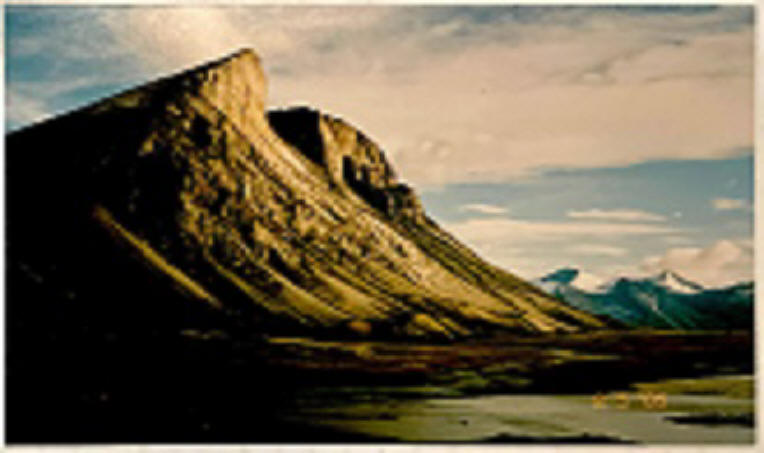
We had recently discovered
backpacking, not so much for the joy of backpacking, but for the places
it could takes us—places you could only go on foot. One was Auyuittuq
National Park in Baffin Island, Canada’s Eastern Arctic. It has a 100 km
hiking route through a spectacular river valley between two mountain
ranges. Behind those mountains are ice fields with some of the oldest
ice on the planet. This includes the Penny Ice Cap, the sole remnant of
the last ice age. The ice flows around the mountains in glaciers that
melt into rushing rivers that feed the Owl River to the north and the
Weasel to the south. The pressure of the ice causes daily rock slides.
It is a wild and primordial place that Parks Canada used to call
“hostile and unforgiving” until someone, likely from the safety of a
far-removed government office, decided the language was too harsh.
We hiked part of the southern
section for four days in 2002. It was our first experience backpacking.
Awestruck by the park’s beauty, we decided to return, and do the entire
100 km trek, something only 40 to 50 people complete each year. But
first we needed a lot more preparation.
There is good reason most folks
take 10 to 14 days to do the trek. While there are some blessed
stretches where you walk on gravel, there are many other areas where you
must struggle your way through tussocks (which is like walking on soggy,
muddy basketballs tethered together with elastics) or clamber over
lengthy debris fields of huge boulders, the older ones covered in
slippery moss. Perhaps toughest of all are the frequent river crossings
through frigid, churning water, clouded with glacial silt so you cannot
see the bottom.
We took three years to increase
our physical conditioning and backcountry skills, including wilderness
first aid and medicine. If you get in trouble in Auyuittuq, no one is
coming quickly.
At least one thing
was easy about this hike: you couldn’t get lost, they said. Just follow
the main river that flowed through the valley. They were wrong.
In early August 2005, we were
ferried by freighter canoe to the north end of the park through water
choked with ice. Five days into the hike, as we neared the highest
elevation on the route, a thick fog descended. We could only see a few
feet in front of us, making our topographical maps useless. Had there
been no fog, we would have seen there was a short stretch of land
between where the Owl River ended and the Weasel began. Instead, blinded
by the fog, we “followed the river” as we had been told to do—except the
river that we followed was pouring off a glacier. We didn’t realize that
the boulders we scrambled gingerly over, some the size of cars, rested
on ice.
For hours we toiled,
and I wondered when we would ever find a place to set up our tent for
the night. Clambering down off a high perch, I wedged one leg under the
lip of the rock to give myself a stable base. Then the unthinkable
happened: As I pushed off onto the other leg, the rock glided forward.
I have heard it said that when you die your life flashes before your eyes. In my case, I didn’t see my life, but my death. It was impossible to pull my leg out, and I knew my lower body would be crushed. That wouldn’t kill me, but I would go into shock, and between that and hypothermia—the temperature was around 5 C—would die within hours. I realized that even if Denis could reach someone quickly on the satellite phone, they wouldn’t be able to get to us in this fog. All of that passed through my mind in a split second as the rock pushed me over. I wasn’t afraid, just surprised. I didn’t think I would die today, I thought
Denis
later told me that he too saw in that fleeting moment the same scenario
and thought, I am going to watch my wife
die today.
Then came the first
miracle. As I pitched forward in seemingly slow motion, the trapped leg
swung effortlessly out from under the boulder. Let me be clear: this was
not a rush of adrenaline giving me super strength. There was no space
for that leg to swing out; it was trapped between moving rock above and
boulders below. But I saw my knee straighten and the leg appear as if it
had passed through rock.
But the
crisis wasn’t over because the rock then smashed into the back of my
leg. I felt a paralyzing stab of agony, then numbness kicked in.
Disbelief at not being crushed swiftly gave way to a primitive terror at
being in a place where rocks the size of vehicles defied gravity and
moved. I started scrambling as fast as I could on hands and feet to get
away. Denis followed shouting at me to stop, but I’d have none of it. As
I scrabbled away, I frantically recalled our wilderness medicine
training. I need shelter. We need to get
the tent up and my leg elevated. The rocks are cold so we can use them
to ice the leg. No, that’s a bad idea. I need to be kept warm to prevent
hypothermia. We’ve got to get the tent up and me in a sleeping bag. But
where? We’ve hiked for hours—there’s no
place for a tent here.
Then came the second
miracle: a gravel spot materialized, exactly big enough for our tent.
Denis caught up to me and we stood open-mouthed for a moment.
Then he turned to
me: “Are you okay?”
“No. I’m pretty sure
my leg’s badly injured.”
We sprang into
action, yanking out equipment, and in minutes had the tent set up. As I
was about to crawl in, a fresh worry struck me. “We need water!” I
wailed. I figured we would have to hunker down for several days until my
leg recovered enough to continue—or until help could come should the
injury prove disabling. Water was heavy and as there was plenty of it
around, we only carried a few hours’ worth at a time. “You are NOT going
near that river!” I added. Denis would have to transverse the sliding
rocks to get there.
Then
my eye fell on a small hole at the edge of the site in the shape of a
perfect equilateral triangle about 6 inches each side. It was filled
with water. I’d
never seen anything like it before, nor would again. “Thank you, God,” I
whispered.
I spent the night
praying and reciting scripture as I drifted in and out of sleep. I had
been memorizing Bible verses that summer and as the hours passed, my
mind kept turning to Isaiah 41:10. The next day, though the leg was
sore, to my disbelief I found I could stand. A few tentative steps
showed I could walk stably. We shifted what we could to Denis’s pack,
but I still had to carry almost 50 pounds. And so we began the arduous
seven-day trek that got us out of the park.
The most daunting challenge was
that each day we had to ford at least one, usually two, glacial-fed
rivers. Before the accident, we would take up to an hour to scout and
find the best place to cross. It was hard to judge where the deep spots
were because of the glacial silt. We would make our best guess about
where the river was most shallow, based on principles we’d been taught.
Still, it was not uncommon to start crossing only to find the route was
too deep, forcing us to backtrack and scout again.
After the accident,
God provided a different method. As we came up to the first, my heart
was in my mouth. These rivers had real force, and it took considerable
strength to cross even in the shallower areas. Would I be able to make
it?
Denis pointed out the most
sensible route, and I swallowed. “Let’s pray.” We clutched each other’s
hands and prayed silently. I repeated Isaiah 41:10, and then added, “I
don’t want you to strengthen me. I just want you to help me!” Bless our
Father for his patience with our childish ways.
Opening my eyes, I
saw a pencil thin line of light zigzagging across the river in spots we
never would have tried. “Umm. I don’t understand it, Denis, but I think
we should cross this way.” I described the route.
“Are you sure?” he
said in an I-think-this-is-a-big-mistake tone of voice.
“No, I’m not. But I’m seeing
something I’ve never seen before. If I’m wrong, we can backtrack.”
“Ooookay.”
The crossing was one
of the easiest we’d had.
After that, at each
river, Denis would turn to me and say, “Where do we cross?” I would scan
and the same thing happened—something that has never happened since, I
would add. I saw a thin, shimmering light as if a golden ribbon was laid
out on top of the water for us to follow. In every case, it proved to be
a great route.
It was not until
after we were out of the park that I learned how extensive were my
injuries. Until then, I had not seen my leg because I had stayed clothed
in two, sometimes three, layers because of the cold. When I uncovered
it, I found a vivid continuous bruise from hip to ankle that wrapped
entirely around my leg. The first night after the hike, when I got up to
go to the washroom, pain knifed through my leg when I tried to stand. It
took all my strength to not scream. In the days that followed, I could
barely hobble a short distance. Yet by our Father’s help, I had trekked
for a week across rocks and tussocks, carrying a substantial backpack,
and forded several powerful rivers, with only slight pain—just enough to
ensure I took particular care. God had truly strengthened me, helped me,
and literally upheld me with his righteous hand.
Events like this are
reassurances that God is with us and takes an active role in our lives.
It is true He rarely makes his providential care so obvious. But if He
did, we would probably do nothing for ourselves and would not mature
into the greatness He plans for us. So, let’s keep sharing our stories!
In those long stretches when our Father may seem absent (but isn’t!),
they will encourage us and give us hope on the journey.
Kathy Belicki is a Professor
Emeritus of Psychology at Brock University in
St. Catharines. Recently retired from full-time academia, she is now
focusing on writing and public speaking.
For more information visit
https://oslregion8.org/kathy_belicki.htm